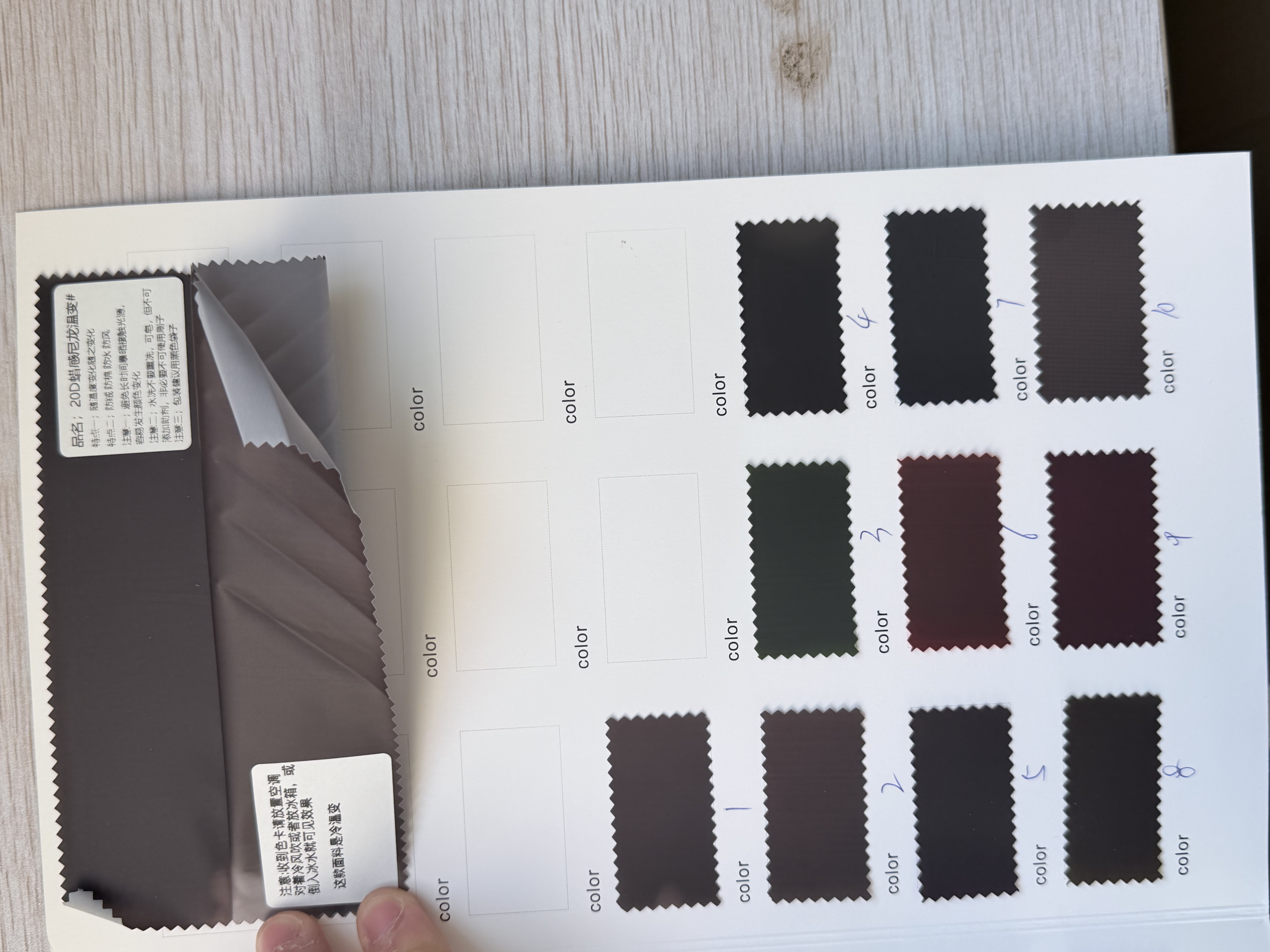
Smart outerwear that changes color with body heat is no longer a gimmick — it is one of the most requested innovations in streetwear and technical apparel this season. Here is how it is actually made, what to test before you commit, and how to brief a factory so your first sample comes back right.
Key Takeaways
- A thermochromic jacket changes color when its print or fabric crosses a set activation temperature; the effect is reversible when it cools.
- Two routes exist: localized reactive printing (graphic-level, from 50 pcs) and custom reactive fabric development (panel or full-garment, from 300 pcs).
- Activation temperature is a design specification — specify it, don't assume it.
- Color cards and loose ink samples cannot confirm a finished jacket. Sample on the real shell fabric, with production screens and curing parameters.
- Test wash fastness, heat cycles, crocking and stretch before bulk — microcapsules degrade with repeated washing.
What Is a Thermochromic Jacket?
A thermochromic jacket is an outerwear garment whose printed graphic or shell fabric visibly changes color when the temperature crosses a set threshold. The effect is reversible: cool the jacket down and it returns to its original state. No batteries, no electronics — the change happens entirely inside the print or textile layer.
For streetwear and lifestyle brands, the effect is a built-in story: a jacket that reacts to a handprint, to sunlight, or to the wearer's body heat. For technical brands, it can function as a simple visual indicator. Either way, the mechanism is the same.
How Does a Heat-Reactive Jacket Change Color?
The color change comes from temperature-responsive pigments, typically encapsulated in microcapsules suspended in a binder system. When the print layer reaches the activation window, the internal color system shifts, changing how the graphic reflects light. When it cools, the system relaxes and the color returns.
The binder matters as much as the pigment. It determines adhesion to the shell fabric, wash resistance, and hand feel. Curing temperature and time affect both durability and the final color response — generic curing parameters cannot be applied across different ink systems.
Thermochromic is often confused with hydrochromic (water-reactive) effects. The difference is fundamental: thermochromic responds to temperature, hydrochromic responds to moisture. Sweat delivers both warmth and moisture at once, which is why the two can look similar in video — but they are completely different material systems.
What Activates a Thermochromic Jacket?
Any heat source that reaches the activation temperature: a warm palm, body heat, direct sunlight, warm air. The activation temperature is a design specification, not an accident.
- A low activation point (e.g. 28–31°C, near body temperature) will react to touch and warm weather — dramatic, but may change color unintentionally in warm climates.
- A high activation point keeps the cold-state graphic longer but requires a deliberate heat source.
Specify your activation temperature and your target sales climate before sampling. A jacket designed for a Scandinavian winter and one designed for a Mediterranean summer should not use the same activation spec.
Two Routes: Print the Graphic or Develop Reactive Fabric?
| Decision | Localized thermochromic print | Custom reactive fabric |
|---|---|---|
| Reaction area | Fixed graphic / localized panel | Large panels or full garment |
| Graphic control | Via screen separations | Coordinated with fabric and cutting |
| Development focus | Ink, screen, shell, curing | Fabric structure, finish, color, garment engineering |
| MOQ (YINCH) | From 50 pcs per design | From 300 pcs per development |
| Best for | Chest/back prints, sleeve details, hidden messages | Full-garment transformation, continuous effects across panels |
Localized printing is the faster, lower-MOQ route for most brands. Custom reactive fabric is the premium route when the whole jacket should transform — but it is a fabric development project, not a print job.
Which Shell Fabric and Artwork Choices Affect the Result?
- Base color and surface: a dark or blended shell reduces clarity because the reactive layer becomes translucent when activated.
- Coverage and contrast: large color blocks read far better than fine lines.
- Stretch: test across chest, shoulders and side seams — print on stretch shells behaves differently under tension.
- Hand feel and breathability: large solid reactive areas need approval on the real shell.
- Color-by-color confirmation: one formulation performs differently on different shades. Confirm each colorway separately.
Design the cold state and warm state side by side, and decide whether the base fabric should participate in the warm-state image.
What Should Be Tested Before Bulk Production?
Microcapsules are lost with washing — one cotton-based study showed significantly greater change after 20 washes than after 5. Washing tests are non-negotiable.
Sample approval checklist:
- Record the cold state.
- Heat and record the warm state.
- Cool and verify full recovery.
- Repeat heat/cool cycles multiple times.
- Wash per the intended care label.
- Check dry/wet crocking, stretch, and cracking.
- Compare against the signed-off reference sample.
Wash fastness should be tested per ISO 105-C06:2010, and care label wording must match the confirmed print system.
What Should a Brand Send for a Quote?
To get an accurate quote and a first sample that is close to final:
- Editable vector artwork (AI / EPS / vector PDF)
- Cold-state and warm-state visuals
- Preferred activation temperature and trigger scenario
- Jacket style, shell fabric, weight, base color
- Print location and dimensions
- Quantity per design
- Target market and testing requirements
- Timeline
Develop Your Custom Heat-Reactive Jacket with YINCH
YINCH has engineered heat-reactive and water-reactive outerwear for over 25 years, serving premium European and global brands from our Quanzhou and Ankang factories. Our Innovation Lab develops thermochromic and hydrochromic coatings, custom laminates, and GRS-certified recycled shells — all produced in a 100% solar-powered headquarters.
- MOQ from 50 pcs (localized reactive print) / 300 pcs (custom reactive fabric)
- Sample within 7 days
- AQL 2.5 inspection, BSCI audited, GRS certified, ISO 9001
Send us your artwork, your cold/warm state visuals, and your jacket spec. Our engineering team will evaluate the print-versus-fabric route and quote within 48 hours.
Ready to engineer your next line?
Request a quote now — our team replies within 48 hours.
Request a Quote NowApprove Two Visual States, Not One Print
The single most common mistake in reactive apparel is approving a print as if it were a static graphic. A thermochromic jacket has two identities: cold and warm. Approve both, under the real activation temperature, on the real shell fabric. Everything else is guesswork.
FAQ
What is a thermochromic jacket?
A jacket whose graphic or fabric changes color at a set temperature, reversibly.
How is it different from a hydrochromic jacket?
Thermochromic responds to temperature; hydrochromic responds to moisture. Different material systems entirely.
Can body heat trigger the change?
Yes, depending on the activation spec and ambient conditions.
Can thermochromic jackets be washed?
Yes, if developed for it — depends on ink, binder, curing, and care label.
Can I use my own design?
Yes. Send vector artwork plus cold/warm state references.
What is the MOQ?
From 50 pcs for localized reactive prints; from 300 pcs for custom reactive fabric development.
YINCH Garment — Apparel Engineering & Innovation Partner. We don't just sew. We engineer.